
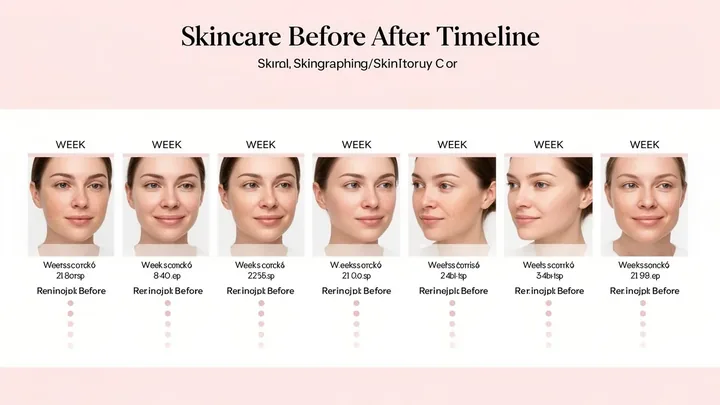
Retinol Before and After: The Complete Week-by-Week Timeline
Last updated: July 29, 2026
Most retinol before-and-after photos skip the messy middle — the peeling, the purging, the three weeks where you wonder if you've made a terrible mistake. This timeline covers all of it.
If you've ever searched "retinol before and after," you've probably seen dramatic glow-ups—smoother texture, fewer breakouts, and softer fine lines. The truth is: retinol can absolutely transform skin, but it does it on a timeline, and the "before" often includes a confusing phase of dryness, flaking, and temporary breakouts.
This guide is designed to answer the questions people actually have:
- When will I see results?
- Is this purging… or a bad reaction?
- Why do some people look amazing in 4 weeks and others struggle?
- What routine gets the best "after" without irritation?
Let's do this the skin-specialist way: clear expectations, simple routine steps, and fewer myths.
The Retinol We Recommend for Beginners (Amazon)
The ceramide-infused formula that reduces the irritation that causes most people to quit retinol in week 3.
Check Price on Amazon →We may earn a small commission if you purchase through our links, at no extra cost to you.
Retinol Timeline at a Glance
Skim the whole 16-week arc before you dive into each stage. Each block below matches an H2 section further down.
Weeks 1–2
The Adjustment Begins
Tightness, mild dryness, faint tingling.
Weeks 3–4
The Purge
Small breakouts and flaking peak. Most quit here.
Weeks 5–8
The Turning Point
Purge fades, texture starts to smooth.
Weeks 9–12
Visible Results
Even tone, softer fine lines, less congestion.
Weeks 13–16
The Payoff
The 'after photo' phase for most consistent users.
Month 6+
Long-Term Changes
Collagen-linked firmness and lasting tone shift.
Weeks 1–2: The Adjustment Begins
What's happening biologically
Retinol converts to retinoic acid in the skin and immediately accelerates keratinocyte turnover. Your surface layer starts shedding faster than it did last month, and your barrier lipids haven't yet re-organized around the new pace. This is why "just starting" often feels drier than "months in."
What you see in the mirror
Skin feels tighter after cleansing. There's a papery quality around the nose and mouth, sometimes a faint warm flush 20 minutes after application. Makeup may cling to a small dry patch on the chin or forehead.
Normal
- Mild dryness or light flaking
- Slight tingling for a few minutes after applying
- Faint pink flush that fades within an hour
Not Normal
- Burning or stinging that lasts hours
- Swelling, hives, or a raised rash
- Cracked, weeping, or bleeding skin
The Retinol We Recommend For Beginners
CeraVe Resurfacing Retinol Serum
The most beginner-friendly retinol available — ceramides in the formula actively reduce the irritation that causes most people to give up in weeks 2 to 4.
View on Amazon →We may earn a small commission if you purchase through our links, at no extra cost to you.
💡 Tip: Two nights a week is enough. Sandwich a pea-sized dose between two thin layers of moisturizer and don't touch anything else acidic during these weeks.
Weeks 3–4: The Purge (Where Most People Quit)
What's happening biologically
Microcomedones that were quietly forming under the surface for weeks are being pushed out faster than they can resolve on their own. At the same time, the accelerated turnover is peaking, so peeling and roughness are usually at their worst. This isn't retinol "damaging" your skin — it's a compressed timeline of things that were going to happen anyway.
What you see in the mirror
Small whiteheads or clogged bumps in your usual break-out zones. Flakes along the sides of the nose. Foundation looks patchy no matter how you prep. Progress photos taken now look worse than the baseline — which is why weeks 3–4 are the single most common quitting point.
Normal (Purging)
- Break-outs in your usual zones
- Blemishes appear and resolve faster than usual
- Flaking around the nose and jaw
Not Normal
- Rash-like bumps in brand-new areas
- Painful, cystic acne that wasn't there before
- Peeling that keeps spreading past week 6
💡 Tip: Do not quit. Drop to twice a week, moisturize heavily, and give it two more weeks before you judge whether retinol works for you.
Weeks 5–8: The Turning Point
What's happening biologically
The barrier is starting to catch up. Ceramide production and corneocyte cohesion adapt to the faster turnover, so flaking eases and stinging becomes rare. The purge backlog empties out, and early collagen signaling is quietly under way in the deeper dermis — you can't see it yet, but it's why the months ahead pay off.
What you see in the mirror
Skin feels smoother when you run your fingertips over your cheeks. Pores look a touch smaller in overhead light. Makeup sits better, and the "am I even getting anywhere?" doubts start to settle.
Normal
- Flaking almost gone
- Fewer clogged pores overall
- Texture feels smoother to the touch
Not Normal
- Continued daily stinging
- Skin still visibly red at rest
- New breakouts spreading to unusual zones
💡 Tip: If everything feels calm, you can now step up to 3 nights a week. Keep the routine boring — no new actives during a ramp-up.
Ready to Step Up? The Mid-Strength Retinol We Recommend
A stronger overnight retinol formula with mineral complex — the natural next step once your beginner serum feels easy.
Check Price on Amazon →We may earn a small commission if you purchase through our links, at no extra cost to you.
Weeks 9–12: Visible Results Begin
What's happening biologically
Melanocyte activity is being modulated, so post-inflammatory marks from old break-outs start to fade. Turnover is now running at a sustainable pace, and the dermis is quietly laying down new collagen fibers. This is the first phase where side-by-side photos actually show something.
What you see in the mirror
Post-acne marks look lighter than two months ago. Skin tone is more even without makeup. The fine crepey lines around the eyes look softer first thing in the morning.
Normal
- Post-acne marks fading noticeably
- More even tone across cheeks and forehead
- Softer look to fine lines
Not Normal
- New patches of dark pigmentation appearing
- Fresh peeling coming back with no routine change
💡 Tip: Daily SPF is the single biggest lever right now. Skipping it in this window will visibly undo the pigment progress you just earned.
Weeks 13–16: The Payoff
What's happening biologically
Collagen deposition is now measurably higher than baseline in most consistent users. Pigment cells respond to normal sun exposure more predictably, and clogged pores form less easily. Skin has essentially been re-taught what "normal turnover" looks like.
What you see in the mirror
This is the moment most people mean when they say "retinol changed my skin." Under natural window light, the tone looks brighter, the surface looks refined, and yesterday's break-out is already almost gone.
Normal
- Notably brighter, more even tone
- Refined pores in the T-zone
- Blemishes heal in days, not weeks
Not Normal
- Sudden return of stinging or peeling
- New sensitivity to products you tolerated for months
💡 Tip: This is the earliest sensible point to consider a stronger percentage — not sooner. Step up one increment at a time and keep the rest of the routine unchanged.
Month 6 and Beyond
What's happening biologically
This is when the deeper, slower work compounds. Sustained retinoid use is associated with continued increases in dermal collagen and elastin remodeling, gradual smoothing of etched fine lines, and a more resilient pigment response. The changes are subtle month-to-month but obvious across a year.
What you see in the mirror
Skin looks firmer at rest. Fine lines around the eyes and mouth are softer without makeup. Old sun spots keep quietly fading. Break-outs are rarer, smaller, and heal without marks.
💡 Tip: The people who see the biggest 12-month "after" are the ones who stayed boring — same product, same frequency, daily SPF, no chasing trends.
Why Your Retinol "After" Might Not Match Someone Else's
Before you compare your photos to anyone else's, check these variables:
The #1 Mistake That Ruins Retinol Results: Using Too Much, Too Soon
Retinol is not a "more is better" ingredient. Using a heavy layer doesn't speed results—it usually speeds irritation.
💡 A practical dose: a pea-sized amount for the full face (or even less if you're sensitive).
How to Take "Before & After" Photos That Actually Show Progress
Most people take random selfies in different lighting and then think retinol "did nothing."
Use this protocol:
Photo Protocol (5 minutes/week)
- Same time of day (morning is easiest)
- Same spot, same lighting, same angle
- Clean face, no makeup
- Take 3 photos: front, left, right
- Optional: one "texture close-up" of problem area
Best Schedule
- Day 1(baseline)
- Day 14
- Day 28
- Day 56
- Day 84
This aligns with the real pace of visible change.
The Safest Retinol Routine for the Best "After"
🌙 Night Routine (Beginner-Friendly)
- 1Gentle cleanser (no scrubs, no harsh acids)
- 2Moisturizer (thin layer)
- 3Retinol (pea-sized amount)
- 4Moisturizer again (optional if sensitive)
This "moisturizer sandwich" approach is commonly recommended to reduce irritation.
📅 Frequency Plan (Simple and Effective)
If your skin stings or peels heavily, step back—not because retinol "failed," but because your barrier needs support.
Recommended Product
CeraVe Retinol Serum for Post-Acne Marks
A gentle, encapsulated retinol with niacinamide and ceramides—perfect for beginners who want to minimize irritation while still getting results.
Check Price on AmazonRecommended Product
La Roche-Posay Cicaplast Baume B5 (Barrier Repair)
The ideal moisturizer for the 'sandwich' method—calms irritation and supports barrier repair while you adjust to retinol.
Check Price on AmazonRetinol + Ingredients: What Helps Your Before/After (And What Slows It Down)
Best Support Partners (Usually Safe + Helpful)
Niacinamide: can support barrier comfort and reduce irritation for many users (great pairing in routine planning).
Hyaluronic Acid: hydration support; helps dryness feel less intense.
Recommended Product
Paula's Choice Clinical 1% Retinol Treatment
A gold-standard retinol paired with peptides and vitamin C for comprehensive anti-aging—ideal for experienced users ready for a stronger formula.
Check Price on AmazonUse With Caution (Often Better on Alternate Nights)
Glycolic Acid / AHA: These can be too much with retinol for many people, especially during the first 6–8 weeks.
Salicylic Acid / BHA: Similar caution applies—alternate nights are usually safer.
Avoid Same Routine (Common Irritation Trap)
Benzoyl Peroxide + Retinol: often too drying/irritating together; many routines separate them.
🔍 Not sure about a combo? Use our Conflict Checker Tool to instantly check if your ingredients are safe together.
Myths vs Facts (The Parts Competitors Often Miss)
Myth: "If retinol irritates you, you must stop forever."
Fact: Mild irritation can be part of the adjustment. The better move is to reduce frequency, buffer with moisturizer, and simplify the routine.
Myth: "Retinol works like an exfoliant."
Fact: It can cause flaking, but its main role is supporting renewal processes and longer-term structural changes—not acting like a scrub.
Myth: "You can't use retinol if you have sensitive skin."
Fact: Sensitive skin often can—just with lower strength, slower frequency, and a barrier-first routine.
Myth: "Retinol before and after is fast."
Fact: Many people see early texture changes within weeks, but meaningful change often needs 6–12 weeks, and continued improvement can take longer.
When You Should Pause Retinol (And Get Help)
Stop and reassess if you have:
- Persistent burning/stinging
- Swelling, hive-like rash
- Cracking, bleeding, severe peeling
- Eczema flare that won't calm in a few days
Retinol should be challenging at first, not damaging.
Recommended Product
Vanicream Moisturizing Skin Cream (Sensitive Skin)
Fragrance-free, dye-free barrier cream recommended by dermatologists for calming retinol-irritated skin.
Check Price on AmazonThe 3 Retinols From This Guide
| Product | Best For | Strength | Action |
|---|---|---|---|
| CeraVe Resurfacing Retinol Serum | Beginners | 0.1% | View on Amazon |
| RoC Retinol Correxion Deep Wrinkle Night Cream | Intermediate | 0.4% equivalent | View on Amazon |
| Paula's Choice Clinical 1% Retinol Treatment | Advanced | 1% | View on Amazon |
We may earn a small commission if you purchase through our links, at no extra cost to you.
Retinol Before & After FAQs
If you want to put this into practice, you can estimate the exact dose your face needs with our SPF calculator, map every step in the right order with our skincare routine planner, design a targeted regimen using our anti-aging routine builder, and see what each bottle actually costs per application with our cost per use calculator.
Final Takeaway: Your Best "After" Comes From Consistency + Barrier Care
If you want results that look like the "after" photos:
And if you're unsure about mixing retinol with another active, use your compatibility tool to keep the routine effective—and calm.
Recommended Product
EltaMD UV Clear Broad-Spectrum SPF 46
The #1 widely recommended sunscreen for retinol users—lightweight, non-comedogenic, with niacinamide to calm skin.
Check Price on AmazonNot Sure What to Mix with Retinol?
Use our free Conflict Checker to instantly verify if your skincare ingredients are safe together.
Check Your Combo Now →Related Reading
Niacinamide and Retinol Routine
The complete guide to using these two together safely.
Lemon8 Skincare Trends: Safe or Dangerous?
We checked 3 viral routines through our Conflict Checker.
Ice Water Facial Benefits
Does the viral ice facial hack actually work?
Retinol + Vitamin C: Safe?
Check the compatibility of this popular combo.
Disclaimer: This content is AI-assisted and human-reviewed for educational purposes only. It is not medical advice. Always patch test new products and consult a dermatologist for individual care. Some links on this page are affiliate links—we may earn a commission at no extra cost to you.