
Retinol for Skin: A Dermatologist's Complete Guide to Retinoids
If you feel your skin is becoming dull, uneven, or you're noticing fine lines and dark spots on your face, the issue is not always your moisturizer. Maybe the problem is that your skin's renewal cycle is slowing down.
Last updated: May 20, 2026
Retinol for skin is widely considered a gold standard in anti-aging skincare and acne treatment. As a vitamin A derivative, it works at the cellular level to stimulate cell turnover, support collagen production, and visibly improve skin texture over time.
But not all retinoids are created equal. And when used incorrectly, they can cause unnecessary irritation.
Recommended For This

The best starting point for any retinol beginner — read the guide then come back to this.
As an Amazon Associate we earn from qualifying purchases. This is at no extra cost to you.
In this medically grounded, evidence-based guide, you'll learn:
- How retinol works beneath the surface
- The difference between retinol, retinaldehyde, adapalene, and tretinoin
- How to use retinoids safely (without damaging your skin barrier)
- Who should avoid them
- What realistic results look like
How Retinol Works at the Cellular Level
Retinol belongs to a class of compounds known as retinoids, all of which are vitamin A derivatives. Once applied, retinol converts inside the skin into retinoic acid — the biologically active form that binds to receptors in skin cells.
1. It Accelerates Cell Turnover
In your 20s, your skin renewal cycle averages around 28 days. As you move into your 30s and beyond, that cycle slows significantly — sometimes extending to 50–70 days. Slower cell turnover leads to:
- Dullness
- Rough texture
- Fine lines and wrinkles
- Uneven pigmentation
Retinol helps normalize and accelerate this process, encouraging the shedding of old surface cells and promoting fresher skin beneath.
2. It Stimulates Collagen Production
Collagen loss is a major driver of photoaging. Studies show that retinoids stimulate fibroblasts in the dermis to increase collagen production, improving:
- Skin firmness
- Fine lines
- Elasticity
This is why retinoids are considered foundational in anti-aging skincare.
3. It Improves Acne and Pore Function
Retinoids prevent clogged pores by regulating how skin cells shed inside hair follicles. This makes them highly effective in acne treatment, especially for:
- Comedonal acne (whiteheads and blackheads)
- Mild inflammatory acne
Recommended Product
CeraVe Retinol Serum for Post-Acne Marks
Gentle encapsulated retinol with ceramides — ideal for beginners starting their retinol journey.
View on AmazonRealistic Timeline for Results
Retinoids are not overnight treatments. Expect:
- 4–6 weeks: Skin adjustment phase
- 8–12 weeks: Texture improvement
- 3–6 months: Visible reduction in fine lines, dark spots, and photoaging
Consistency is key.
📖 Already using retinol? Check our Retinol Before and After Timeline for a detailed week-by-week breakdown of what to expect.
Types of Retinoids Explained: Which One Should You Choose?
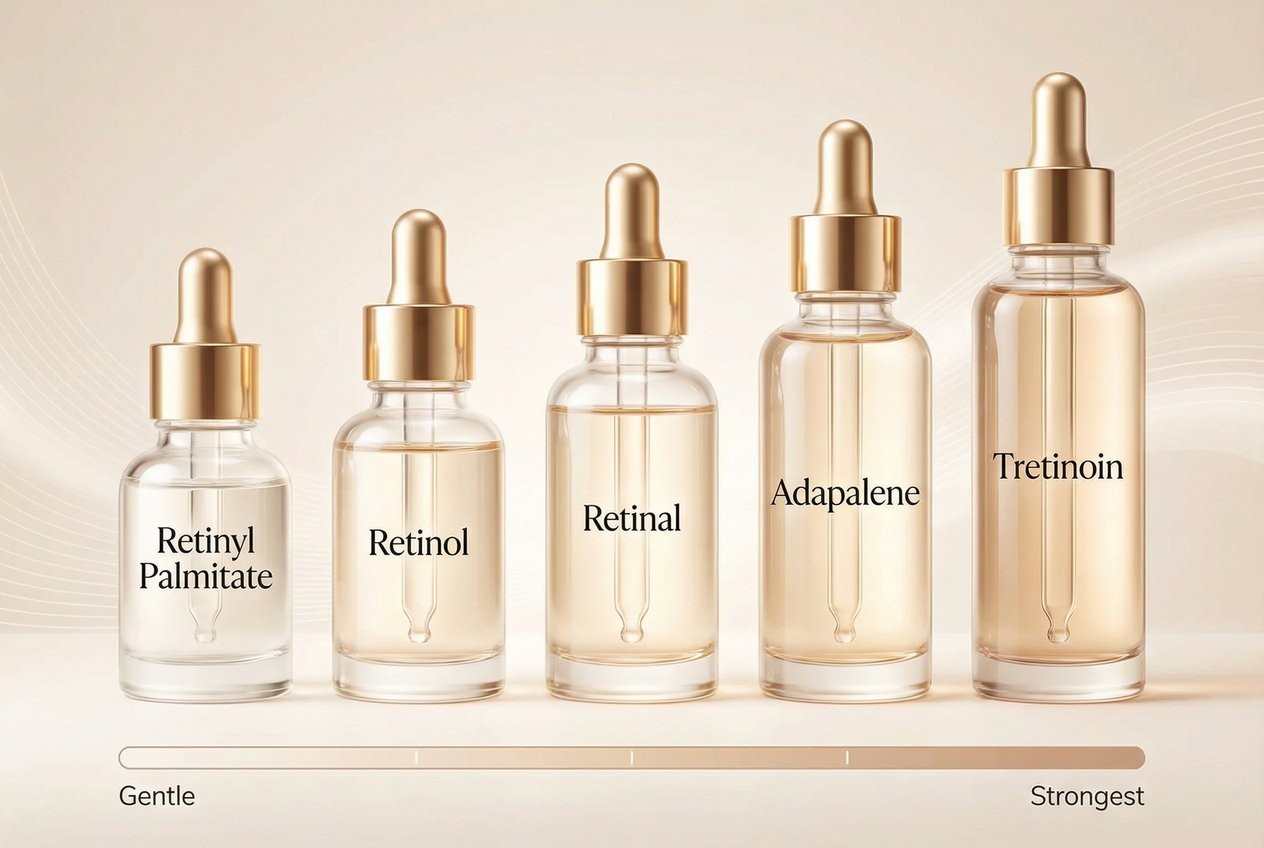
All retinoids eventually convert to retinoic acid in the skin — but they differ in strength, irritation potential, and speed of results.
1. Retinyl Palmitate (Gentlest)
- Weakest over-the-counter form
- Multiple conversion steps required
- Best for very sensitive skin or beginners
2. Retinol (Moderate Strength)
- Most common OTC retinoid
- Requires two conversion steps
- Effective with manageable irritation
- Ideal starting point for most users
3. Retinaldehyde (Stronger)
- One step closer to retinoic acid
- Faster results than retinol
- More irritation potential
4. Adapalene (Prescription or OTC 0.1%)
- Synthetic retinoid
- Designed primarily for acne treatment
- More stable and often less irritating than tretinoin
5. Tretinoin (Prescription Strength)
- Pure retinoic acid
- No conversion required
- Fastest results
- Higher likelihood of irritation
Important Clinical Insight
Long-term studies suggest that lower-strength retinoids can deliver similar anti-aging benefits over time compared to stronger ones — with fewer side effects. More strength does not always mean better results.
Recommended Product
La Roche-Posay Retinol B3 Serum
0.3% pure retinol with niacinamide and hyaluronic acid — reduces wrinkles with less irritation.
View on AmazonRetinol for Beginners: How to Start Safely and How Often to Use It
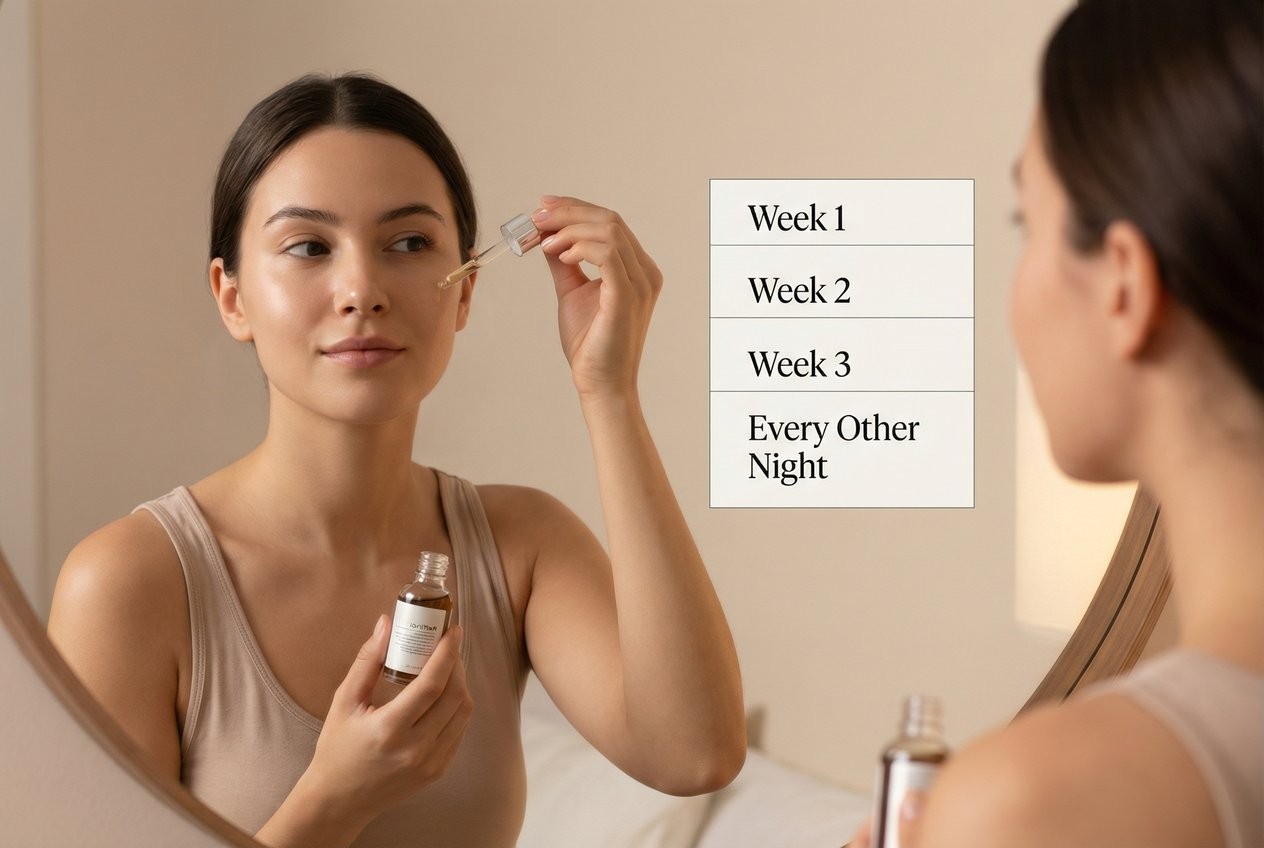
If you're new to retinol, the key is to start slow and build tolerance gradually. Skincare beginners should not apply retinol every night from day one, as this increases the risk of irritation and skin barrier damage.
How Often Should Beginners Use Retinol?
- Week 1: Apply once a week at night
- Week 2: Increase to twice a week
- Week 3: Use three times a week
- Then gradually move to every other night, depending on skin tolerance
Most beginners do well with every-other-night use rather than daily application.
Beginner Retinol Tips
- Use a pea-sized amount for the entire face
- Apply on completely dry skin
- Follow with a gentle, fragrance-free moisturizer
Recommended Product
Vanicream Gentle Facial Cleanser
Fragrance-free, soap-free cleanser perfect for retinol users with sensitive skin.
View on AmazonHow to Use Retinol for Skin Correctly (Step-by-Step)
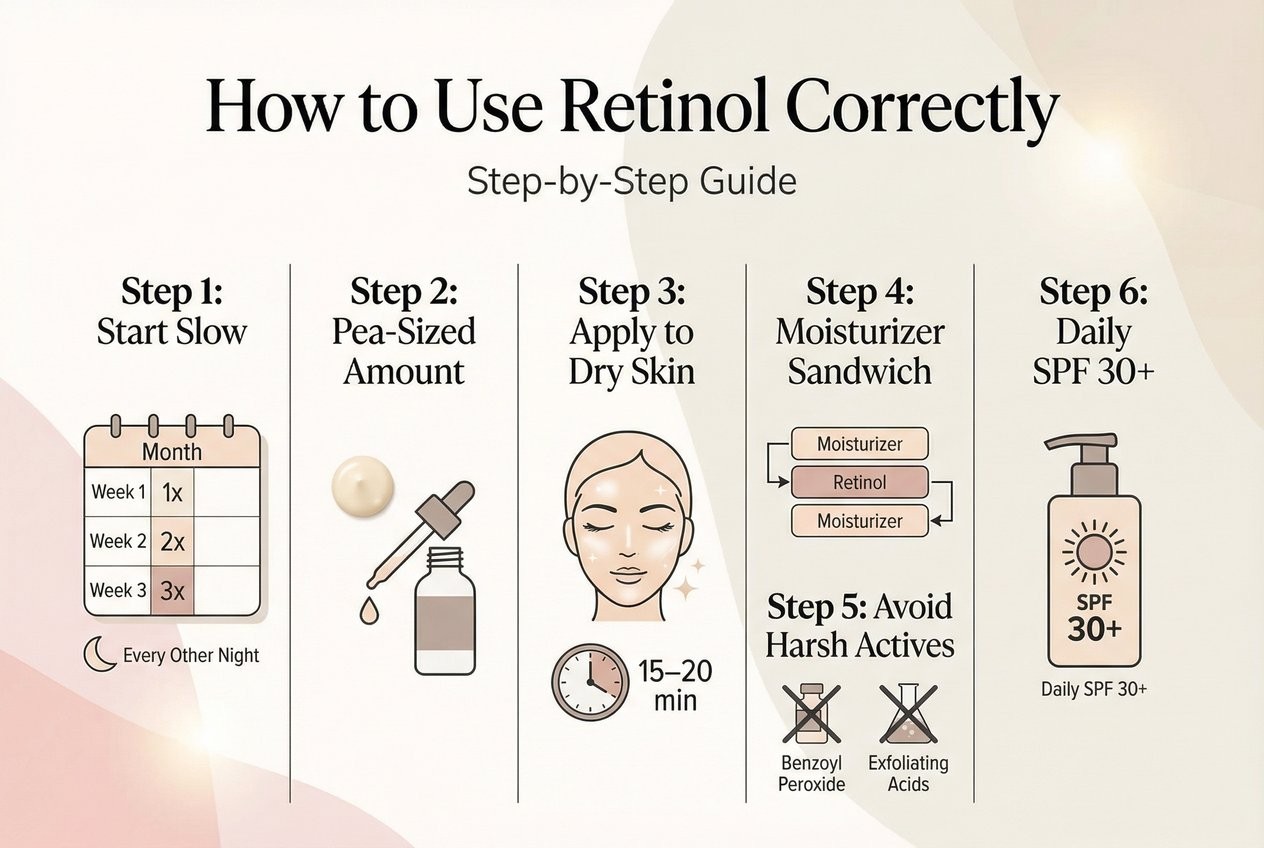
Improper use is the most common reason people quit retinoids.
Step 1: Start Slowly
Follow a gradual introduction schedule:
- Week 1: 1 night per week
- Week 2: 2 nights per week
- Week 3: 3 nights per week
- Then: Every other night
Increase frequency only if your skin tolerates it well.
Step 2: Use a Pea-Sized Amount
A pea-sized amount is sufficient for the entire face. Applying more increases irritation — not effectiveness.
Step 3: Apply to Dry Skin
Wait 15–20 minutes after washing your face before applying retinol to reduce irritation risk.
Step 4: Use the Moisturizer Sandwich Method (Optional)
For sensitive skin:
- Apply moisturizer
- Apply retinol
- Seal with another thin layer of moisturizer
Step 5: Avoid Mixing with Harsh Actives Initially
Do not combine on the same night with:
- Benzoyl peroxide
- High-strength salicylic acid
- Exfoliating acids
Alternate nights instead.
Retinol + Niacinamide
Niacinamide supports barrier comfort and reduces retinol irritation.
Retinol + Hyaluronic Acid
Hydration support helps offset dryness from retinol.
Retinol + Glycolic Acid
Better on alternate nights — can be too much together initially.
Retinol + Salicylic Acid
Use on separate nights, especially during the first 6–8 weeks.
Retinol + Benzoyl Peroxide
Often too drying and irritating together — separate them.
Retinol + Vitamin C
Use vitamin C in the morning, retinol at night for best results.
Step 6: Always Use SPF 30 Sunscreen
Retinol increases photosensitivity. Daily SPF 30 sunscreen or higher is mandatory to prevent photo damage and protect results.
Recommended Product
EltaMD UV Clear Broad-Spectrum SPF 46
Dermatologist-recommended daily sunscreen — mandatory when using retinoids.
View on AmazonSide Effects: Purging vs Irritation
Normal Adjustment Symptoms
- Flaking
- Mild redness
- Temporary breakouts (purging)
Purging occurs because retinoids speed up the surfacing of clogged pores. It typically resolves within 4–6 weeks.
Signs of True Irritation
- Severe burning
- Swelling
- Cracking skin
- Persistent stinging
If this occurs:
- Reduce frequency
- Increase moisturizer use
- Consider switching to a gentler retinoid
Skin Barrier Support Tips
To protect your skin barrier:
- Use fragrance-free moisturizers
- Avoid over-exfoliation
- Skip physical scrubs
- Stay consistent but patient
Recommended Product
CeraVe Moisturizing Cream (Barrier Repair)
Essential ceramide-rich moisturizer to support skin barrier during retinol use.
View on Amazon🔍 Want to know which actives are safe with retinol? Use our Conflict Checker Tool to instantly check ingredient compatibility.
Beyond Wrinkles: Full Benefits of Retinoids
Retinoids are not just for fine lines and wrinkles. They also help improve:
Top Rated Products For This Routine

As an Amazon Associate we earn from qualifying purchases. This is at no extra cost to you.
Acne and Breakouts
Regulate oil production and prevent clogged pores.
Hyperpigmentation & Dark Spots
Speed removal of pigmented surface cells.
Texture and Skin Clarity
Smooth rough patches and refine pores.
Photoaging
Reduce visible damage caused by UV exposure.
Because retinoids work at the cellular level, they can transform overall skin quality over time.
Who Should Avoid Retinoids?
While retinoids are dermatologist recommended for many patients, they are not suitable for everyone.
Avoid or consult a physician if you:
- Are pregnant or breastfeeding
- Have an extremely compromised skin barrier
- Are experiencing an active rosacea flare
- Have severe eczema
Always consult a board-certified dermatologist before starting prescription tretinoin or adapalene.
Common Myths About Retinol
Myth: Stronger is always better.
Truth: Lower strengths can be equally effective long term.
Myth: Retinol thins the skin.
Truth: It thickens the dermis by stimulating collagen while thinning the outermost dead layer.
Myth: You can't use it in summer.
Truth: You can — with strict daily sunscreen use.
FAQ: Retinol for Skin
Can I use retinol every night?
Eventually, yes — but only after gradual introduction and if your skin tolerates it.
Is retinol safe for sensitive skin?
Yes, if started slowly and paired with barrier-supportive moisturizers.
How long before I see results?
Expect visible improvements in 3–6 months.
Can I use retinol with vitamin C?
Yes, but ideally at different times (vitamin C in the morning, retinol at night).
Is prescription tretinoin better than over-the-counter retinol?
Tretinoin works faster but carries higher irritation risk. Both are effective long term.
Conclusion: Choose Wisely and Be Consistent
Retinol for skin remains one of the most studied and dermatologist recommended ingredients in modern skincare.
When used correctly, it can:
- Improve fine lines and wrinkles
- Support collagen production
- Treat acne
- Fade hyperpigmentation
- Enhance overall skin renewal
But results require patience, proper technique, and sun protection.
If you're unsure which retinoid is right for you, consult a qualified dermatologist. The best anti-aging skincare routine is one tailored to your skin type — not trends.
Not Sure What to Mix with Retinol?
Use our Conflict Checker to instantly see if your skincare ingredients are safe to combine.
Check Your ComboRelated Articles
Retinol Before and After: The Real Timeline
Week-by-week breakdown of what to expect
Niacinamide and Retinol: Can You Use Them Together?
Safe layering guide for this powerful duo
How to Layer Skincare Actives Safely
Beginner's complete guide to active layering
What Not to Mix: Dangerous Skincare Combos
The 5 most dangerous ingredient pairings
Medical Disclaimer: This article is for informational and educational purposes only and is not a substitute for professional medical advice. Always consult a board-certified dermatologist before starting any new skincare ingredient, especially prescription retinoids. Individual results may vary.
